
'From tariff tensions and border skirmishes to unrest in West Asia.' 'The worst may be behind us. But any further upmove will now have to come from earnings.'

Gold prices could hit the $3500 an ounce (oz) mark in the next 18 months - up around 13 per cent from the current levels - given the global uncertainties and aided by investment demand, said analysts at BofA Securities in a recent note. Uncertainty around Trump Administration trade policies, BofA said, could continue to push the US dollar (USD) lower, further supporting gold prices near-term.

A lower risk appetite among investors has driven gold, traditionally a safe-haven asset, to record highs so far this year. Fuelled by geopolitical tensions in West Asia, robust demand from central banks - particularly in Asia - and US President Donald Trump's tariff volleys, spot gold touched an all-time high of $2,956 per ounce on February 24 in the international markets.

From the Sensex firms, Infosys declined by 3.54 per cent. Power Grid, Eternal, HCL Tech, Tata Consultancy Services, Bharti Airtel, IndusInd Bank, NTPC and HDFC Bank were the major laggards. Sun Pharma, Adani Ports, Bajaj Finance, State Bank of India and Tech Mahindra were the gainers.

Foreign Portfolio Investors' (FPIs) selling spree continues as they pulled out over Rs 3,400 crore from the Indian equity markets in the first three trading sessions of November on rising interest rates and geopolitical tensions in the Middle East. This came after such investors withdrew Rs 24,548 crore in October and Rs 14,767 crore in September, data with the depositories showed. Before the outflow, FPIs were incessantly buying Indian equities in the last six months from March to August and brought in Rs 1.74 lakh crore during the period.

Exports of 19 major commodities, including petroleum products, coal and marine items, saw growth in terms of volume during April 2023-February 2024, even as they witnessed contraction in value terms during the same period. Government officials said the rise in export volume despite a decline in value implies that these commodities show a stronger market demand.

'It's clear that fans are eager to be part of the live stadium experience, reflecting a growing trend of travel driven by marquee sporting events.'

Analysts are warning of growing risks to the market's sustained momentum, and even to the possibility of consolidation at current levels. Domestically, markets are grappling with several challenges, including a slowing economy, as indicated by the latest GDP data for the July-September (Q2) quarter of 2024-25 (FY25), sticky inflation, fluctuations in the rupee, waning consumption, and high interest rates.

Air passengers might have a reason to smile this Diwali season as average airfares on many domestic routes have dropped 20-25 per cent compared to the year-ago period, according to an analysis. Increased capacity and the recent fall in oil prices are considered to be among the factors for the fall in air ticket prices. The analysis by travel portal ixigo showed that average airfare on the domestic routes have declined in the range of 20-25 per cent.

Domestic gold jewellery consumption is likely to decline by 9-10 per cent in 2025-26, mainly due to a 33 per cent surge in gold prices, a report said on Thursday. The consumption of bars and coins increased 17 per cent and 25 per cent, respectively, in FY24 and FY25, reflecting investor preference for safe-haven assets amid global macroeconomic uncertainty and heightened geopolitical and trade tensions, Icra said in the report.

'We expect market consolidation and recommend buying during market dips.'

The Reserve Bank of India (RBI) added another 102 metric tonnes to the domestically held gold in the April-September period, as per a disclosure made on Tuesday. The overall quantity of the precious metal stored in local safes stood at 510.46 metric tonnes as of September 30, which was up from over 408 metric tonnes as on March 31, 2024. The central bank said it added another 32 metric tonnes of gold reserves in the six-month period to take the overall tonnage to 854.73 metric tonnes, as per the half yearly report on management of foreign exchange reserves.

India continues to remain an attractive investment destination and rise in repatriation of funds is a sign of a mature market where foreign investors can enter and exit smoothly, Reserve Bank Governor Sanjay Malhotra said on Friday. Gross foreign direct investment (FDI) inflows remained strong, rising by around 14 per cent to $81 billion in 2024-25, from $71.3 billion a year ago.

'Countries like Cambodia, Vietnam, Laos, and the Philippines have a 50 per cent increase in bookings.'

Foreign investors have pulled out Rs 22,420 crore from the Indian equity market so far this month, owing to high domestic stock valuations, increasing allocations to China, and the rising US dollar as well as Treasury yields. With this sell-off, Foreign Portfolio Investors (FPIs) have recorded a total outflow of Rs 15,827 crore in 2024 so far. As liquidity tightens, FPI inflows are expected to remain subdued in the short term.

Ask rediffGURU and PF expert Milind Vadjikar your insurance, stocks, mutual fund and personal finance-related questions.

'The shifts in US involvement in global conflicts and geopolitical alliances could introduce uncertainties.'
Investments by private equity and venture capital funds declined by 35 per cent to $4.4 billion in April compared with $6.8 billion in the year-ago period, a report said on Thursday. The number of deals in April stood at 98, which was 56 per cent higher than the year-ago period, the report by EY, a consultancy firm, and industry lobby grouping IVCA said.

Foreign investors were net sellers of domestic debt in October for the first time since the official inclusion of Indian government bonds in the JP Morgan bond indices, with net outflow worth Rs 4,697 crore. This marked the second instance in the current calendar year where foreign portfolio investors (FPIs) were net sellers in a month.

Gold prices slumped for the second straight session by Rs 1,150 to Rs 78,350 per 10 grams in the national capital on Monday on frantic selling by stockists and retailers, the All India Sarafa Association said. The precious metal of 99.9 per cent purity closed at Rs 79,500 per 10 grams on Friday.

The S&P BSE Midcap and the S&P BSE Smallcap indices have managed to stay afloat in a volatile January that saw the frontline indices hit their respective 52-week high levels and then slip. While the S&P BSE Sensex has lost over 2 per cent thus far in January, the S&P BSE Midcap and the S&P BSE Smallcap indices have gained nearly 2.5 per cent and 4 per cent, respectively during this period.

The prospect of protracted uncertainties in the global economic landscape not only pose a risk for India's growth outlook in 2025-26, but are also likely to dent the private sector's capital raising and investment plans, the finance ministry averred on Tuesday, cautioning the country's corporates that the era of 'easy pickings' was over.

Investors' wealth eroded by Rs 9.51 lakh crore on Monday morning, following a crash in equity markets where the benchmark Sensex tanked over 2,400 points, mirroring a sharp plunge in global peers. The 30-share BSE benchmark tanked 2,401.49 points to 78,580.46 in early trade. Following the sharp decline in equities, the market capitalisation of BSE-listed firms dropped by Rs 9,51,771.37 crore to Rs 4,47,65,174.76 crore ($5.35 trillion) during the morning trade.

India's stock markets are experiencing a shift in investor sentiment, with a 30 per cent surge in Chinese stocks, prompting investors to move money from domestic markets to China. This reversal of fortunes is a notable change from the past three years, where China's losses benefited India.

The Pakistan Cricket Board (PCB) has confirmed that the Pakistan Super League (PSL) will continue as scheduled despite escalating tensions with India.

'If gold's recent surge has increased its allocation beyond 15 per cent in your portfolio, now may be a good time to rebalance.'

For India to transform into a high-income country with a projected gross domestic product (GDP) of $23-35 trillion, will need a sustained annual growth of 8 per cent to 10 per cent. This will be powered by India's demographic dividend, technological innovation, and sectoral transformation, according to the "India@2047: Transforming India Into A Tech-Driven Economy" report by Bain & Company and Nasscom. By 2047, the services sector is expected to contribute 60 per cent of India's GDP, while manufacturing will account for 32 per cent, both playing a pivotal role in economic expansion.

GST 2.0 may cushion consumers against US tariffs, but like the 2019 corporate tax cut, it risks being another tactical fix rather than a structural growth strategy, expects Debashis Basu.

Indian economy is in a sweet spot, with a mix of solid growth and moderating inflation, Moody's Ratings said, forecasting a 7.2 per cent GDP growth in the 2024 calendar year and 6.6 per cent in the next. In its Global Macro Outlook 2025-26, the rating agency said the global economy has shown remarkable resilience in bouncing back from supply chain disruptions during the pandemic, an energy and food crisis after the Russia-Ukraine war began, high inflation and consequent monetary policy tightening.

The government's target of hitting $52 billion to $58 billion in mobile phone exports in FY26 has been faltering; an Indian corporate group with financial muscle will help.
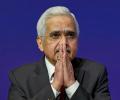
The highlights of RBI's bi-monthly monetary policy announced by Governor Shaktikanta Das:

The IPL 2025 season was thrown into turmoil on Thursday night after the Punjab Kings vs Delhi Capitals match was abruptly halted

The MiG-21 episode demonstrates that procurement is always strategic.
Choices about what aircraft to acquire, who builds them, who supplies the spares, who trains the pilots and technicians are decisions with political consequences lasting for decades.

Among the Sensex firms, Infosys, Bharti Airtel, NTPC, Tata Motors, IndusInd Bank, Bajaj Finance, ICICI Bank, Tech Mahindra, Titan and Axis Bank were among the major laggards. Tata Steel, State Bank of India, Mahindra & Mahindra, Maruti and Nestle were the gainers.

The era where nations thrived through rigid alignments is giving way to an age where the connective State defines power. For India, that era has arrived, points out Dr Nishakant Ojha.

The resilience of the economy and strength of domestic demand will continue to make India an engine of growth amid the rapidly evolving global trade landscape as a result of US tariffs, Finance Minister Nirmala Sitharaman said in London on Tuesday.

India's merchandise exports dipped by about one per cent to $38.01 billion in December 2024 against $38.39 billion a year ago, according to government data released on Wednesday. Imports increased by 4.8 per cent to $59.95 billion in December 2024 compared to $57.15 billion in the year-ago month.

Any correction in Indian equities is an opportunity for investors to put in money for the long term

The top 20 fund houses held 6.8 per cent of their portfolios in cash as of May 31, down from a record high of 7.2 per cent in April 2025.

Dalal Street had a roller coaster ride in 2024 from shattering record after record to facing heavy correction off-late but equity markets still rewarded investors with positive returns, driven by a surge in domestic fund flows and a resilient macro landscape. The first half of the year saw robust corporate earnings, a surge in domestic flows, and a resilient macro landscape, driving the Nifty to an all-time high of 26,277.35 in September 2024, according to Motilal Oswal Wealth Management.
